


Hanoi’s urban planning system was born in the context of the lack of land preparation as well as the sense of control of development in order to create an effective connection between the system of stations and centers of concentration in urban areas. As a solution, the lines and stations are planned between the main roads or underground because of lack of land and planning before. There have been many calls for the development of urban renewal combining urban renewal, but there is no pressure to force urban development projects to effectively connect with urban areas.
General Plan Hanoi 2030 lists a number of general requirements for the development of the development of the ICP – but has not paid much attention to the feasibility of the requirements or the implementation of coordinated measures. M & E is considered as an infrastructure system that can be implemented and implemented independently through specialized transport projects of HAIDEP, TEDI and others, while the coverage and quality of the projects. This project actually has problems. In order to promote the effectiveness of the RWSS system, it is necessary to combine the planning of the railway system with the renovation and urban planning – including the preparation of the land fund, the planning of the development of the public space system and Walking routes, crowded areas such as markets, supermarkets, service centers, offices, hospitals, schools … This will help to enhance attractiveness, convenience and suitability. The reason for walking space is that Hanoi has become a suitable place for walking lifestyle and using public transport (GTCC) in line with the trend of green, sustainable and energy saving. present of the world.
However, this is not a simple task and depends very much on the economic potential of the city. What should be done in the short term is to identify the key elements likely to have a fundamental impact on the performance of the task – to develop appropriate control measures.
This article aims to unearth arguments about the prominent elements of Hanoi’s development of the current urbanist system, focusing on the meaning, role, and behavior of these elements. The idea of improving and developing the “core” of spontaneous development is also mentioned as a noteworthy solution, which is likely to create a chain of pedestrian / commercial service centers / GTCC / employment / Large scale entertainment – not only enhances the appeal of walking and the GTCC, but also contributes to the improvement of existing developmental defects.
SIGNIFICANT ELEMENTS AND MEANS OF Capital
Capital is often considered as the most important factor in building urban infrastructure, especially the system of urban development. In fact, the rate of return on capital is important. The key issue is the policies and mechanisms that allow the exploitation of the benefits that can come from the projects of the community. This is something that many experts have mentioned. Of these, the approved network has played a decisive role in the future, because once the planned routes are built, there is little chance of change or adjustment.
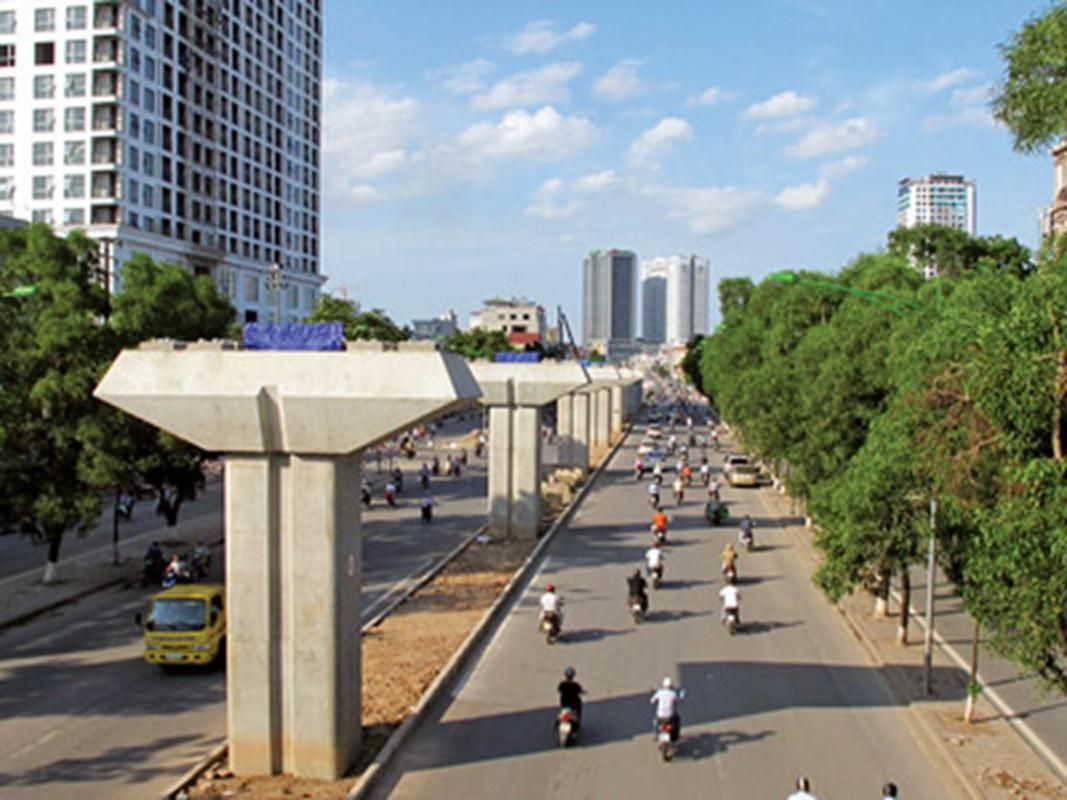
With the choice of arranging the main routes parallel to the main roads, these lines do not open more opportunities for land development and urban renewal, but only to increase the access for the. The building has been developed, with good access along the main road – which is not a major concern for owners. Therefore, it would be difficult for the urban development projects to capitalize on the added value of land plots owned by the developer.
Technology and management
In the official statements, technology roles and ways of administering the syllabus are over-emphasized, considered as the most important elements. This should be considered as a separate issue of the project. For urban and urban futures, it is important that the level of relevance, performance, and impact of the urban planning system. Thus, a system of requirements as the basis for management and development; specific mechanisms to encourage development; and clear specific support commitments – are essential to ensure the competitiveness, relevance, and future of the development of the RS.
The station and the link between urbanism and urbanism
This is an issue that many experts consider to be most important for promoting the effectiveness of the RS system but is rarely mentioned in practice – largely due to the lack of prior preparation, the limited purpose of the RDT projects. , as well as the complexity of the problem. In the long run, the efficiency and the revenue of the RS system depend mainly on the level of comfort and suitability of the connections between the urban railway and urban railway stations, namely: walking routes, the medium crowded center and operation, parking lots, transit systems. Although we may not be able to do so, we have to take into account the development of the area around the station for the next 20 years to take appropriate measures.
Remove personal vehicles, using public transportation
Most researches on this issue agree that the main reason people use motor vehicles (especially motorbikes) is their flexibility, convenience, and suitability for multi-purpose vehicles. number of people. Therefore, besides the “negative” measures to make it more difficult for individual vehicles to become more difficult – the main problem is to build up the system to become more flexible, convenient and suitable for the item. Daily travel of different objects. When the quality of vehicles and the alignment of GTCC (except MSM) can be adjusted with little difficulty – the quality of pedestrian space and GTCC is in fact a decisive factor in the tendency to abandon the medium individuals in the long run.
Walking space
Supporting the development of pedestrian spaces is the policy of the Hanoi government and planning, with the recent result of the formation of more pedestrian streets in central Hanoi. However, in order for people to actually walk every day, walking spaces must exist everywhere, to meet the daily needs of many people, to connect well with public transport, and convenient, convenient. To the extent that people see walking is really more attractive.
In addition to the many organizational design principles, walking space can be easily found in specialized materials. Particular attention should be paid to the development of walking space in Hanoi in particular and Vietnam in general as negative impacts of hot and humid climates. If there is no solution to dry, airy, shady spaces, all other efforts will not make much sense – by walking in the sun, in the hot, humid climate is the torture of everyone. . This explains why the majority of people often walk, practice running in the early morning or late afternoon; Or just take a walk around the large lake with many trees.
Certainly, Hanoi will need a lot of time and effort to build a quality walking space system for people to walk. For the future, from now on, Hanoi should set up a network of walking space combined with the organization of the public transport system, tourism, social infrastructure and trade in services – with the important objectives of standardization. Land fund, renovation orientation and new construction. Immediate regulations for the construction of pavement roofs or independent walkways should be provided to provide a uniform basis for urban management.
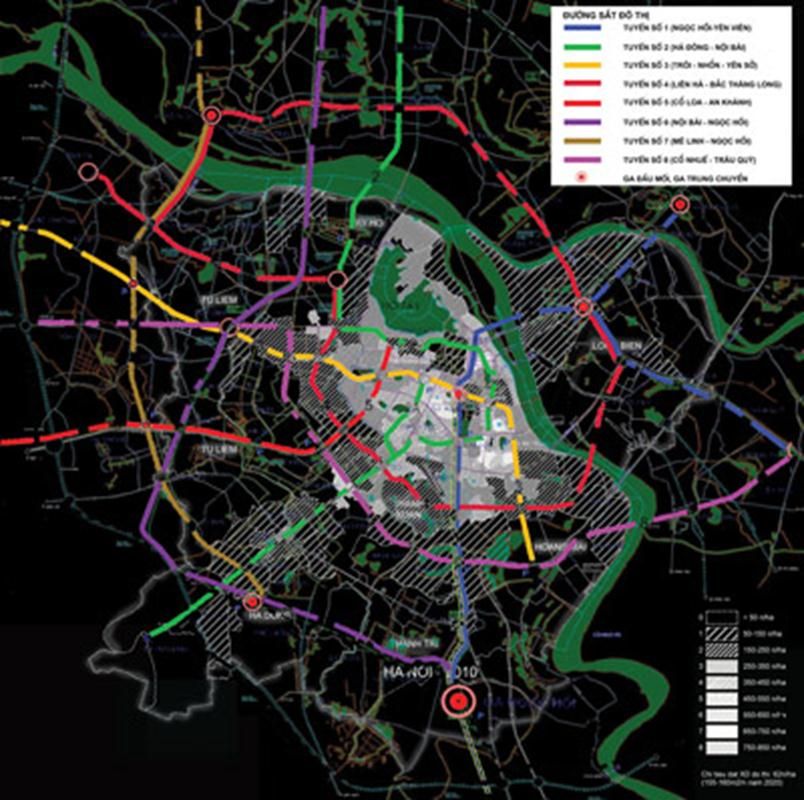
The system of distribution and distribution of population in Hanoi (2010). The urban railway network has only been established and has not yet been linked to the detailed plans. (Figure from: Private investigation on the population of the wards in Hanoi by Dr. Nguyen Ngoc Quang, http: / General planning of Hanoi to 2030 with vision 2050
DEVELOPMENT OPPORTUNITIES
Development context
Hanoi is now a combination of planned areas (old town, old town and new urban areas) intermingled with spontaneous development zones and large works or clusters built on plots. old land. With a large area, narrow pathways under the fish bone structure, and very high construction density, spontaneous development zones function as “dense” blocks in urban areas, where vehicles are almost impossible to travel. through. As a result, vehicles are often forced to use the main roads that make the roads overloaded, causing congestion. Most of the large-scale construction works on the old land plots only contributed to increasing the pressure on traffic. Building many roads through spontaneous development is the basic solution to perfect the Hanoi road network. However, due to the high cost of compensation, Hanoi may only be able to clear the ground to open some of the main roads, spontaneous development zones will remain long-term. These zones will continue to increasingly obstruct Hanoi’s traffic – no matter how new urban areas are built – if we do not know how to look the other way.
Opportunity from defects
The nature of the development of the spontaneous zones is to cling to the outer corridors, constantly inward in the open alleyways until they occupy the empty land. From outside, the economic value of land plots gradually reduced; The solid level of the works also tends to decrease. For most developed land the core is the cheapest and easiest to buy to create a large plot of land. The only thing that has not been bought and developed into apartments, or office shopping centers, is that there is no convenient transportation.
If they create convenient transportation and provide more quality services, this core area will become the ideal new residence because they are located between the new urban areas and the old center of Hanoi.
Core renovation of spontaneous development zones
Briefly, the idea of improving the core of spontaneous development zones is as follows:
– Buying and consolidating land plots of little value in the core to create a large plot of land with all the alleyways connecting to the main road;
– On the large plot of land that has just been created, construction of an underground parking lot, quality indoor and outdoor walking space (indoor and outdoor), railway station, play spaces, entertainment facilities, high-rise apartment buildings (serving both local relocation needs);
– Renovate the alleys to create quality walking spaces, connected to other walking spaces.
– If possible, arrange a station near the main road as possible to limit changes to the route, but still connect well with the system of walking space in the core.
– In the areas with very high construction density, especially the outer ring, the stations can connect with each other by small capacity monorail overhead and connect with the railway station.
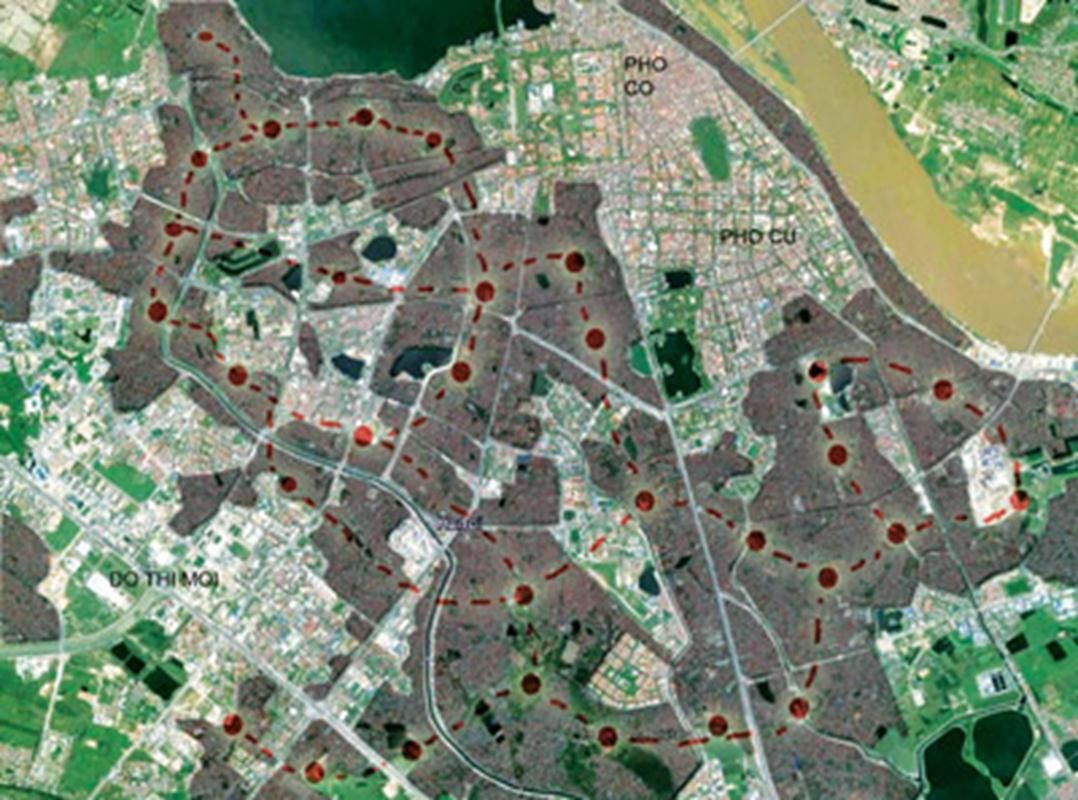
Spontaneous (dark) developmental areas, such as those that block traffic in urban areas, cause traffic to all main roads, causing overload. Opening roads through these areas helps increase traffic capacity, but it is both difficult and costly as encouraging people to use personal vehicles. If these places are a chain of employment centers, services, linked to a network of on-site walking spaces and a GTCC system – will create a very comfortable walking / using environment. At the core of many spontaneous development sites are very central, but are growing poorly just because there are no accessible traffic (Figure from Google Earth 2014).
Theoretically, this solution could significantly increase the level of access and core value. Due to the ability to gather large land fund at the core, it is possible to form a system of space walking quality and safety for the area, not only convenient connection to the railway station but also the works of translation and the development of additional parking at the core. In this way, not only can urban areas really be adapted to walking and public transport, but it can also improve the quality of life, create jobs, vitality and attractiveness. Urban development spontaneously. The core of spontaneous development zones is likely to become the chain of new centers, which will attract users from the old center of Hanoi and from new urban areas, mainly through walk and urban systems. .
In fact, this is obviously a very difficult task as it involves buying land and clearing land. However, it seems that this is one of the few options that Hanoi has to do to walk and the GTCC really become a new travel, convenient and attractive.
In addition to the necessary planning and management changes, at least urban renewal is an integral part of planning the construction of the station. It is necessary to assign the right to propose the adjustment of the planning, construction and implementation of the project to the investor of this work. In addition, due to the objective of supporting the lifestyle of walking and public transport, urban renewal and the construction of the railway station, these projects need to be authorized by the Hanoi government to have a larger population and housing area. Compared with the general regulations, to increase the feasibility and attractiveness of the projects.

